Introducing the AREAS Framework
Watching What They Do


This past week, we wrote about a problem that challenged us as we built the 10F Forecasts: the standard categories for making sense of geopolitics — Global North/South, democracies vs. autocracies, East/West, developed/developing — don’t describe what’s actually happening anymore. We promised we’d walk through what we built instead.
This is that post.
The Problem, Briefly
When you’re tracking ten simultaneous global transformations — shifts in how transparency works, how alliances form, how people move, how money flows, how energy gets controlled, how technology fragments — you need a way to map who’s doing what. The conventional move is to sort actors into fixed, often pre-ordained, groups. Allies and adversaries. Trading and security blocs. Income categories. Lumped together by geography.
The trouble is that the same actor can be doing completely different things across different domains. China is building sovereign data infrastructure from scratch (that’s one kind of strategic move) while being profoundly shaped by climate dynamics it didn’t design and can’t fully control (that’s a very different one). The EU is architecting regulatory frameworks for AI while several of its own members are building parallel systems specifically to avoid those frameworks.
Amid all of this, sectors, companies, communities and even individuals have positioning, depending on the topic.
Fixed categories can’t hold this. They tell you who someone is. They don’t tell you what they’re doing, where, or why it might change.
What AREAS Does
AREAS is a framework we developed for the 10F project to map strategic positioning during systemic transformation. It asks one question: given a particular shift that’s underway, what is this actor actually doing in response?
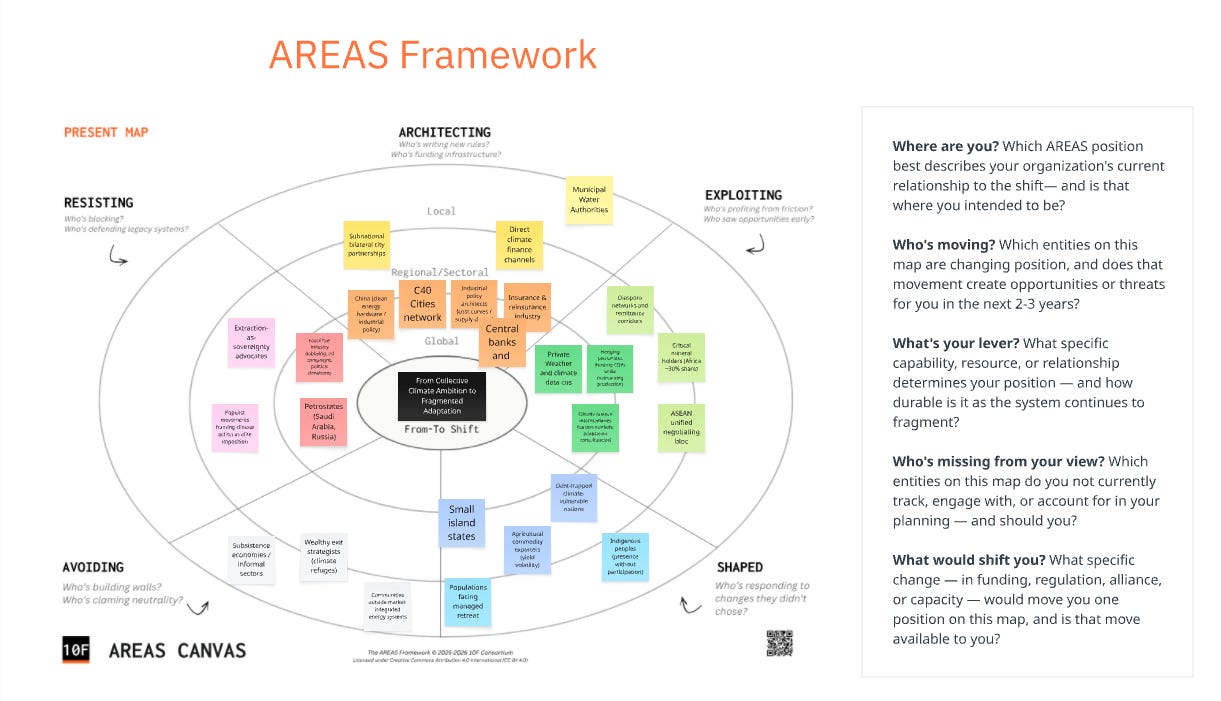
There are five positions.
Architecting — creating and controlling the new system. Writing the rules, building the infrastructure, defining what comes next. This is maximum agency. China architecting data sovereignty. Central banks architecting digital currencies. Tech platforms architecting the norms around AI governance before regulators can get there.
Resisting— fighting to preserve existing arrangements or prevent the transformation. The EU pushing disclosure requirements against the tide of engineered opacity. Japan defending quality certification standards as global supply chains fragment. Small island nations resisting the collapse of collective climate commitments. Fossil fuel lobbies resisting energy transition.
Exploiting — finding advantage in the cracks. Every transformation creates friction, and someone figures out how to work that friction. Singapore and the UAE turning regulatory arbitrage into a national business model. Data brokers getting rich on the information asymmetries everyone else is complaining about. Turkey making itself indispensable as the corridor between systems that won't deal with each other directly. Exploiting isn't a moral judgement here — it's how a lot of the real action happens.
Avoiding — trying to stay outside the transformation’s direct effects by building parallel systems or maintaining alternative arrangements. Mutual aid networks bypassing collapsing formal institutions. Decentralised protocols routing around state control. Indigenous communities maintaining governance structures that don’t depend on the systems currently breaking down.
Shaped — being reshaped by forces you didn’t choose and/or can’t currently redirect. Migrants whose options are determined by border securitisation regimes. Civil society organisations being reshaped by funding collapses they didn’t cause. Small businesses being remade by platform economics. Being shaped isn’t passive — it involves constant adaptation — but it means navigating rather than steering. Shaped is where most of the world actually lives in these transformations, and it deserves proportional weight.
The Key Move
AREAS doesn’t assign one universal position to one actor. It maps positions per domain or shift.
The same government might be architecting new trade rules, resisting climate commitments, exploiting regulatory gaps in AI, avoiding engagement on migration, and being shaped by monetary system changes — all at the same time. That’s not inconsistency. That’s how strategy actually works when the world is running multiple incompatible games simultaneously.
This is what we mean by positioning over identity. You don’t ask “is India an ally?” You ask “what is India doing in this specific transformation, and is that position stable?”
Once you start mapping this way, things become visible that weren’t before.
You can spot where potential coalitions exist that conventional analysis misses. Two actors who are adversaries in one domain might share positioning in another — and that shared positioning might be the basis for practical cooperation that identity-based analysis would never surface.
You can see where actors are vulnerable. If someone is being shaped across most domains, they have limited room to manoeuvre. If they’re architecting in one area but shaped in three others, their architecture might be more fragile than it looks.
And you can track movement. Positions shift. An actor being shaped today might accumulate enough capability — or find the right crisis — to start resisting, or even to leap to architecting. Watching for those shifts is early warning.
A Note on What It Isn’t
AREAS emerged from Western strategic planning traditions — scenario methods, political economy, systems thinking. It works best for mapping actors making deliberate choices within or between competing systems. It may not capture collective decision-making models or positioning strategies rooted in different cultural logics. We’re interested in learning where it breaks.
What You Can Do With This
Every 10F Forecast includes an AREAS landscape — a mapping of who’s architecting, resisting, exploiting, avoiding, and being shaped within that particular transformation. That gives you a snapshot of the present.
But the framework is also a planning tool. You can use it in two modes:
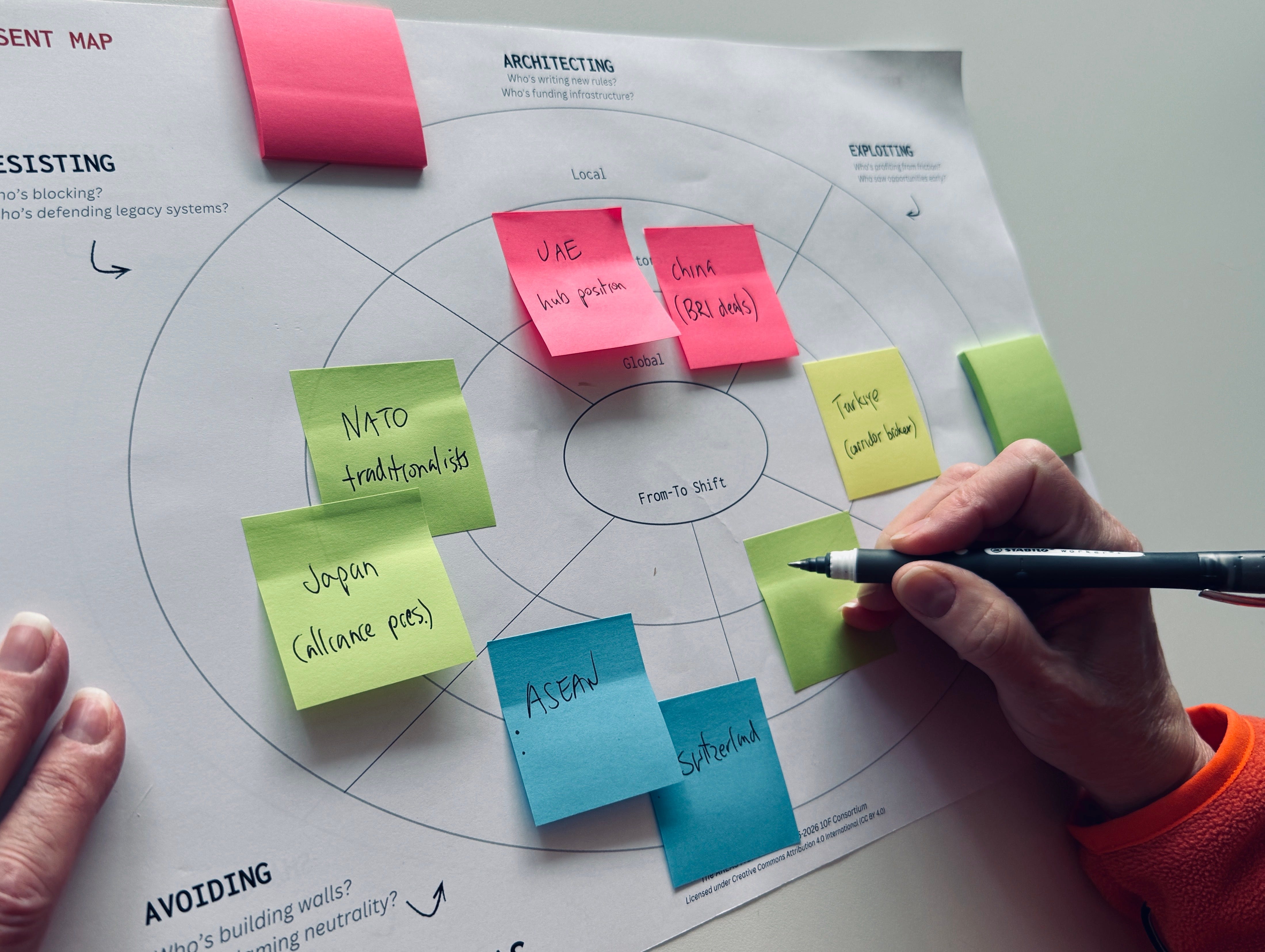
First, map the present. For any transformation you’re tracking, place the relevant actors — states, platforms, organisations, communities, sectors — into AREAS positions. Who’s architecting? Who’s resisting? Who’s exploiting the friction? Who’s building alternatives? Who’s being shaped? Just doing this exercise with your team will surface assumptions you didn’t know you were carrying.
Then map a preferred future. Where would you want these actors to be positioned for things to go better — or at least for your organisation to have more room to operate? The gap between those two maps is where strategy lives. Which actors need to move? What would it take? Which shifts depend on other shifts happening first? What are you assuming that might not hold?
You can do this on a whiteboard, in a spreadsheet, in an interactive canvas like Miro (just import the downloadable worksheets), or on old-fashioned paper. Remember, one of the main benefits of a framework like AREAS is its power as a convening tool — a social object around which groups can voice, visualise and strategise how they see the world now and in the future.
If you want to push the analysis further, you can take your two maps — present and preferred — and use them with an AI tool like Claude or ChatGPT to stress-test your assumptions, surface blind spots, and identify structural barriers you might be too close to see. We’ve published a structured prompt for doing this on our GitHub, designed to produce useful output rather than generic consulting language. The quality depends entirely on how honestly you’ve mapped the positions — both present and preferred future — in the first place. This prompt is designed to work with the actors and positions you've already mapped, not to do the thinking for you.
The questions worth exploring:
When you’re only mapping the present, you’re asking: who’s actually in charge of this shift? Who’s fighting it, and do they have the resources to sustain that? Who’s making money from the friction? Who’s getting reshaped without a say? Are there positions nobody is occupying — and what does that empty space mean?
When you add the preferred future layer, you’re asking: which actors would need to move for things to go better? What would it take to shift someone from being shaped to resisting, or from resisting to architecting alternatives? Where are the dependency chains — shifts that have to happen in sequence, not in parallel? What are you assuming that might not hold?
You can find the full AREAS framework document, and the canvas tool, at 10fconsortium.org/areas
Working with the 10F Network
The Forecasts are open access. The expertise behind them is also available to help you extend, deepen, or explore what they mean for your organisation. Many 10F contributors are independent practitioners who can work with organisations to localise forecasts to your region or sector, run AREAS mapping workshops with your team, turn the analysis into actionable strategy, develop a 10F-focused keynote for your audience, develop forecast briefings, or help you figure out which shifts matter most for your specific context.
Contact us at info@10fconsortium.org with your need, and we’ll connect you with the right people.
10F Convenings
Following last week’s issue, we’ve had a number of people reach out across the world to discuss running local convenings of their own. We welcome this, and are quickly building a lightweight toolkit for running your own 10F Convening. Watch this space for more info, and please do reach out to the 10F team if you think organizing something local can help your community make sense of the unfolding transition.
Share this post with one person you think could benefit from it.
Follow the Project
Beyond this newsletter, you can find 10F on:
LinkedIn — 10F Consortium — longer-form updates and discussion
Bluesky — @10fconsortium.bsky.social — signal tracking and real-time commentary
Instagram — @10fconsortium — visual summaries and forecast highlights
GitHub — 10F Consortium — full forecast archive with version history and transparency
 | A guest post by
|
 | A guest post by
|
 | A guest post by
|
 | A guest post by
|
 | A guest post by
|